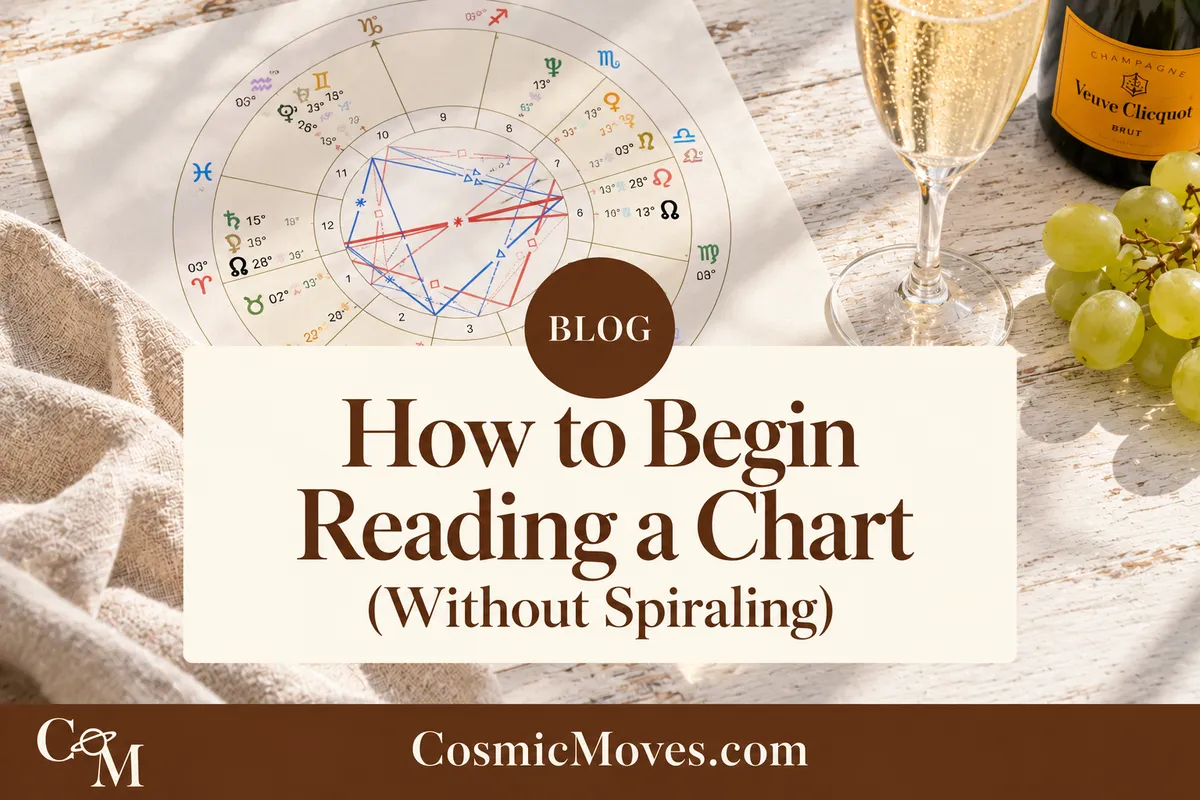
How to Begin Reading a Chart (Without Spiraling)
You open a birth chart and immediately see twelve possible places to begin.
The Sun catches your attention. Then a cluster of planets. Then an aspect you don’t recognize. A few minutes later, you have several tabs open and no idea which question you were trying to answer.
Sound familiar?
Reading a chart becomes more approachable when you give yourself a way into it. In my “How to Begin Reading a Chart (Without Spiraling)” workshop, we practice six steps that help you start a conversation with the chart and develop your own approach over time.
1. Decide what you’re trying to do
Before choosing a placement, pause to consider your purpose.
Are you exploring your own chart? Practicing with a chart you’ve never seen? Helping a friend understand a particular question?
Each situation invites a different conversation. You might be looking for self-understanding, a chance to practice, or a way to be helpful. You might also notice a wish to get everything right.
Knowing which intention is leading can help you choose where to put your attention.
Try this: Finish the sentence, “Today, I’m looking at this chart because…” Keep that intention nearby as you explore.
2. Know your lens
We bring our own experiences to a chart.
Perhaps someone close to you has a Virgo Sun, so Virgo placements immediately catch your attention. Perhaps you’ve spent months studying Saturn, while another planet still feels unfamiliar.
Those associations influence what you notice and how you interpret it. They can create blind spots, and they can also be part of your developing voice.
Recognizing your lens gives you a chance to separate an observation from an assumption.
Try this: Ask yourself, “What do I already associate with this placement, and where did that association come from?”
3. Notice before you interpret
Give yourself one minute to look at the chart without deciding what anything means.
Write down five things you notice. You might see a cluster of planets, an open area of the wheel, a repeated sign, or a shape formed by the aspect lines.
Where does your eye go first? Is one side fuller than the other? What simply makes you curious?
You can practice observing even when you don’t yet know the names of everything you see.
If you’re exploring someone else’s chart with them, invite their observations too. The symbol they keep returning to may open a useful conversation.
Try this: Make your five observations before reaching for an interpretation. Notice how much you can see when you give yourself that space.
4. Choose an anchor
Your anchor is the place you decide to begin.
The Sun, Moon, or rising sign can offer a familiar starting point. You might choose a planet you know well, a repeated pattern, or a placement connected to the question you’re exploring.
If the conversation is about relationships, Venus may be a useful anchor. If you’ve been studying Saturn, you might begin there and practice what you’ve learned.
You don’t have to establish the single most important feature of the chart before taking a first step.
And you’re allowed to consult your resources. A guide, your notes, or a reference book can support your learning as you build familiarity.
Try this: Choose one anchor and write down why it feels useful for this particular conversation.
5. Ask, “What else?”
Stay with your anchor for a little while. There may be more to explore there than you first realize.
Work through a few questions:
What? What does this planet or point tend to describe?
How? How might its sign shape its expression?
Where? What area of life does its house bring into focus?
With whom? What aspects connect it to other planets?
In what context? What do you know about the person’s experience or the question they brought?
This gives one placement room to become more than a keyword. You can consider its symbolism, your associations, and the context before moving elsewhere in the chart.
Try this: Add three questions or observations about your anchor before selecting another placement.
6. Translate it into a question
Once you’ve gathered information, think about how to bring it into a conversation.
You might ask:
“How does this show up for you?”
“What comes to mind when you hear that?”
“How would you describe this part of yourself?”
A question gives someone room to connect the symbolism with their own experience, or to tell you that your interpretation doesn’t fit.
Someone new to astrology may need different language from someone who has studied for years. The person’s circumstances matter too. Let what you hear shape how you continue.
Try this: Take one interpretation you’re considering and turn it into an open question.
Give yourself a way to begin
You can return to these six steps whenever a chart starts to feel overwhelming: name your purpose, recognize your lens, observe, choose an anchor, explore it, and ask a question.
With practice, you’ll learn which starting points help you and which questions lead to useful conversations. Your approach can grow alongside your understanding.
When you’re reading with someone else, remember that they bring the lived experience. Your astrology becomes most useful when you make room to listen.
You don’t need to explain the entire chart today. Begin with one thing you notice.
Want to practice with guidance and room for questions? Journée is my astrology learning community, where we explore charts together and connect what we’re learning with everyday life.
Keep reading: 3 Ways to Read Your Birth Chart Without Knowing All the Astrology.