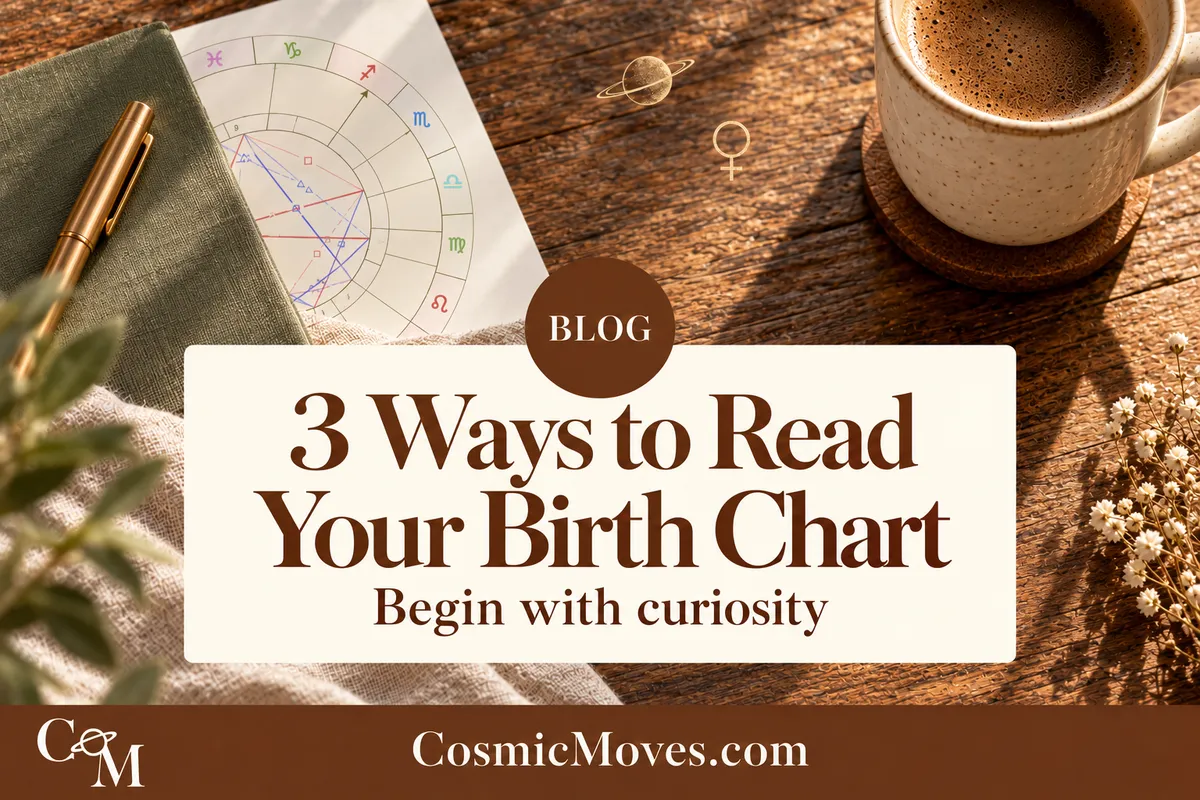
3 Ways to Read Your Birth Chart Without Knowing All the Astrology
You open your birth chart, ready to learn something about yourself.
Then come the symbols. The numbers. The lines. The twelve houses and all those planets.
Where do you even begin?
You don’t need to understand everything in your chart before you can begin exploring it. You can start with curiosity, a little guidance, and your own experience.
In my “3 Ways to Read Your Chart” workshop, we explore three ways to make that first connection.
1. Trust your cosmic intuition
Give yourself thirty seconds to look at your chart without trying to interpret it.
What catches your eye?
Perhaps it’s a cluster of planets, a particular symbol, or a part of the wheel you’ve never noticed before. Let that be your starting point.
You don’t need to explain your choice. You’re choosing something to explore.
Once something has your attention, look up its meaning. There is no shame in consulting a guide! You don’t earn extra astrology points for memorizing every keyword before you begin.
A resource can help you understand what a planet or sign represents. Then you can bring your own questions:
Where do I recognize this theme in my life? How do I experience it? What feels familiar, and what am I still curious about?
For example, if a planet in Leo catches your eye, you might explore that planet’s themes alongside Leo’s associations with creativity and self-expression.
The goal is to build a relationship with your chart, one observation at a time. Let your intuition guide your curiosity, and give yourself room to discover something unexpected.
Try this: Choose one placement that draws your attention. Look it up, then write a few sentences about how its themes relate to your experience.
2. Follow the Moon
The Moon gives you something to return to regularly as you learn.
In astrology, we associate her with emotions, instincts, and our inner world. Following her movement offers a way to explore those themes through everyday observation.
You can begin with new and full moons.
Use a new moon as a moment to consider what you want to begin or nurture. At the full moon, reflect on what has become clearer, what is reaching completion, or what you’re ready to release.
Keep a few notes about your mood, energy, and what is happening in your life. Over time, you’ll have your own record to revisit.
If you’d like to go further, notice the Moon’s zodiac sign and explore its themes. Does the symbolism give you a useful question to sit with? Do you notice a recurring pattern, or does your experience differ?
You can also follow the Moon in relation to your birth chart. When she reaches a natal planet’s position, explore that planet’s themes. Mercury might prompt reflection on conversations or learning; Venus might invite attention to relationships, beauty, or creativity.
You’re learning to observe and interpret. There’s no need to make every feeling fit an astrological explanation.
Try this: Keep a short Moon journal for a month. Record what you actually notice before reading an interpretation, then compare the two with curiosity.
3. Discover your energetic wave
This is an exercise I use to explore the rhythm of a chart.
Start by listing your planets in order of their degree within a sign, from 0° to 29°, regardless of which sign they occupy.
For example, your list might begin:
Mars at 2°
Jupiter at 10°
Venus at 15°
For this exercise, you’re looking at the degree numbers rather than moving around the zodiac wheel in sign order.
Which planet comes first? Which comes last? Where do several planets sit close together in degree, and where are there larger gaps?
I call this sequence your energetic wave.
Use it as a prompt to explore how different planetary themes relate to one another and to your experience. If Venus comes first, for example, you might reflect on the role that connection, creativity, or beauty plays when you begin something.
Planets near one another in this list may sit in different signs. Their actual angular relationships still matter when you explore aspects. The wave gives you another starting point for noticing possible connections.
Try this: Write out your planetary sequence. Choose two neighboring entries and explore their themes. Where do you recognize those themes working together in your life?
Begin with the approach that interests you
You don’t need to practice all three methods at once.
Follow something that catches your eye. Make a few notes at the next new moon. Write out your planetary sequence.
Then return to your chart and see what you notice next.
Familiarity grows through those small encounters. A symbol you once had to look up becomes recognizable. A question leads to a connection. Your own experiences give you something to bring to the next exploration.
You’re allowed to learn as you go.
Want guidance and space to ask questions along the way? Journée is my astrology learning community, where we explore charts through teaching, practice, and conversations about everyday life.