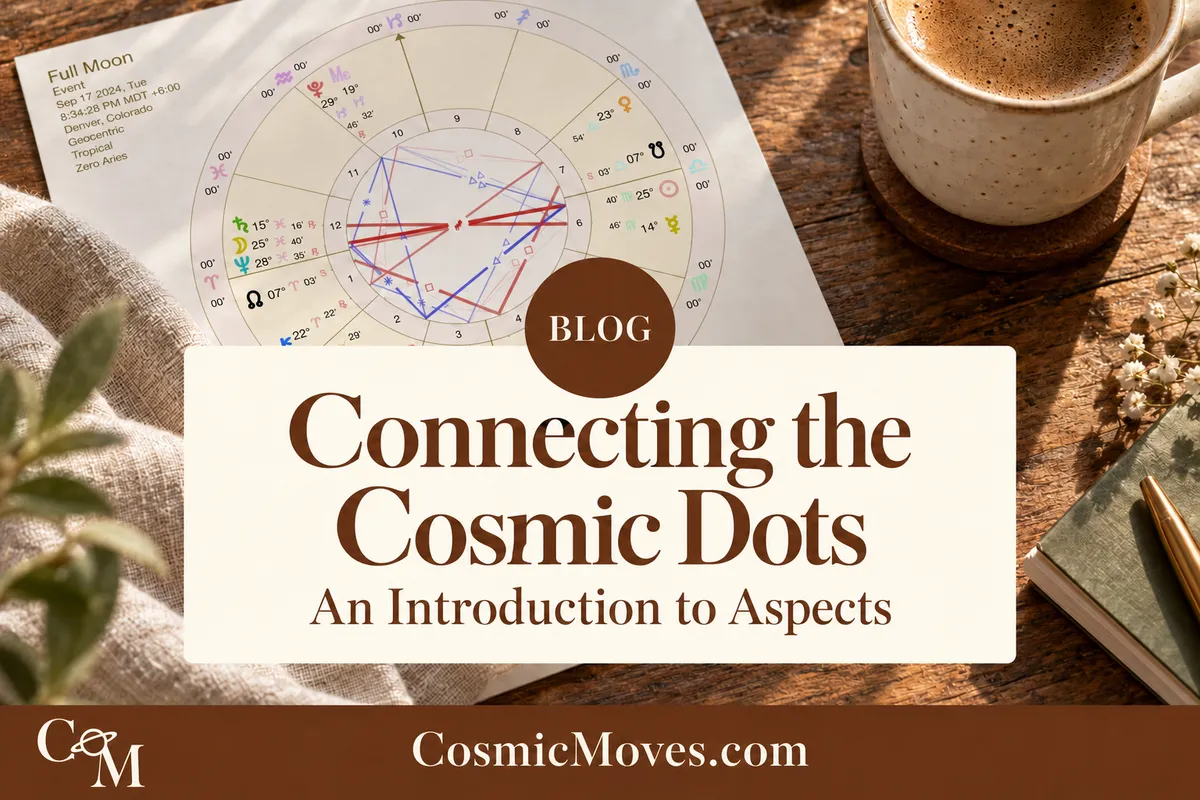
Connecting the Cosmic Dots: What Are Aspects in Astrology?
You’ve looked up your Sun, Moon, and rising sign. You’re beginning to recognize the planets and find your way around the houses.
Then you look at all those lines crossing the middle of your birth chart.
What are they doing in there?
Those lines represent aspects, the relationships between planets. They help us move from understanding individual placements to seeing how the chart works together.
Think of your chart as a conversation. Some planets find an easy rhythm together. Others interrupt, disagree, or ask each other to stretch. Understanding aspects gives you another way to connect what you see in your chart with what you recognize in your life.
What is an aspect?
An aspect is an angular relationship between two planets, measured in degrees around the chart’s 360-degree circle.
The angle helps describe the kind of interaction astrologers interpret between those planets. Are their themes closely blended? Is there an opportunity for cooperation? A tension asking for attention?
You don’t have to memorize every angle before you begin exploring. Start with the relationship: which planets are involved, and how might their themes interact?
Meet the five major aspects
These five relationships are often called the Ptolemaic aspects. They’re a useful place to begin.
Conjunction: a close partnership
0 degrees
With a conjunction, two planets sit close together in the zodiac. Their themes blend, sometimes so closely that it can be difficult to experience one without the other.
In the workshop, Sun conjunct Mercury is an example: identity and thinking are closely connected.
A conjunction can feel concentrated and powerful. Whether that combination feels comfortable depends on the planets involved and the rest of the chart.
Sextile: an opportunity to participate
60 degrees
A sextile suggests cooperation and potential. There may be something available to you, but making use of it involves participation.
Venus sextile Mars, for example, can be explored through creative passion and artistic drive. What might happen when you give that creative impulse somewhere to go?
The invitation is to notice the possibility and engage with it.
Square: tension that asks for movement
90 degrees
A square brings friction between planetary themes. You might recognize competing impulses or a situation that keeps asking you to respond differently.
That can be uncomfortable. It can also become a place where you develop skill through practice.
Rather than deciding that a square is a problem in your chart, begin with a question: What are these two parts of my experience asking me to work with?
Trine: a familiar flow
120 degrees
A trine suggests ease between planetary themes. It can describe a strength or way of responding that feels natural.
Sometimes that ease is so familiar that you barely notice it. Something you assume everyone can do may actually be one of your gifts.
Where do you find yourself thinking, Doesn’t everyone do it this way? That can be an interesting place to begin looking.
Opposition: room for both sides
180 degrees
An opposition places planets across the chart from one another. Their themes can feel like opposite ends of a seesaw, with your attention moving between them.
The work is often about integration: recognizing what each side contributes and making room for both.
You don’t have to declare one side the winner to understand the relationship.
Is an aspect good or bad?
In this approach, no aspect earns a permanent “good” or “bad” label.
Ease and tension describe different experiences. An easy pattern may be something you appreciate, develop, or take for granted. A challenging pattern may ask for attention and become something you understand more deeply over time.
An aspect also belongs to a whole chart. The planets, signs, houses, and your lived experience all contribute to the interpretation.
One line across the wheel cannot tell your entire story.
Start with one conversation
Choose one aspect in your chart that catches your attention. You don’t need to interpret everything today.
Ask yourself:
Which two planets are involved?
Does their relationship suggest blending, opportunity, tension, ease, or balance?
Where might I recognize those themes in everyday life?
Treat your first interpretation as something to explore. Notice what fits, what doesn’t, and what questions emerge.
Over time, those separate placements begin to connect. You start recognizing what I call the hum of your chart: the interplay of its different rhythms, familiar strengths, and places that invite more attention.
That’s where astrology becomes a practice you can return to.
Want to explore those connections with guidance and room for questions? Journée is my astrology learning community, where we bring charts into conversation with everyday life through teaching, practice, and shared discovery.